Did you know that the average American family throws away nearly $1,500 worth of food every year? Most of this waste happens because we simply don’t know how to organize a refrigerator for maximum freshness. In 2026, our refrigerators are smarter and more energy-efficient, but they still rely on basic thermodynamics. If you are shoving your groceries onto whatever shelf is open, you are accidentally shortening the life of your food.
As a kitchen efficiency expert based in Austin, I view the refrigerator as a “Cold Chain” system. Every shelf has a different temperature and humidity level. Mastering how to organize a refrigerator for maximum freshness is about matching your food to its perfect environment.
Here is my 2026 professional blueprint for a perfectly organized fridge.
Table of Contents
1. The Upper Shelves: Consistent Temperature
The top shelves have the most consistent temperature in the unit.
- What goes here: Ready-to-eat foods, leftovers, drinks, and deli meats.
- The Efficiency Hack: Use clear, stackable bins to group your “Quick Grab” items. This prevents you from leaving the door open for 60 seconds while you hunt for a snack, which is a major Kitchen Efficiency Tip.
2. The Lower Shelves: The Coldest Zone
Cold air sinks. Therefore, the bottom shelf is the coldest part of your refrigerator.
- What goes here: Raw meat, poultry, and fish.
- The Freshness Hack: Keeping raw meat on the bottom shelf isn’t just about temperature; it’s about safety. If a package leaks, it won’t contaminate the food below it. Always use a dedicated “Meat Tray” to catch potential drips.
3. The Refrigerator Door: The “Danger Zone”
If you are looking for how to organize a refrigerator for maximum freshness, the first thing to change is your door storage. The door is the warmest part of the fridge because it is exposed to room-temperature air every time you open it.
- What goes here: Condiments, juices, and water.
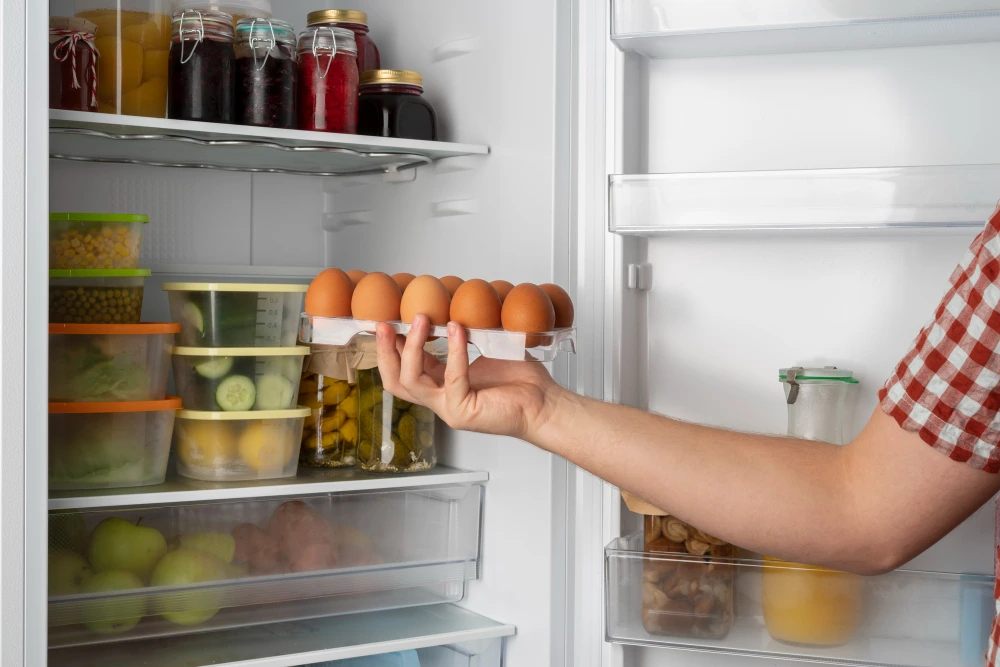
- What NEVER goes here: Milk and eggs. Despite what the built-in holders suggest, milk and eggs will spoil days faster if kept in the door. Move them to the back of the middle shelf.
4. The Crisper Drawers: Humidity Control
Modern 2026 refrigerators feature “Smart Crispers” with humidity sliders.
- High Humidity (Closed Vent): Best for greens that wilt (spinach, herbs, broccoli). The moisture stays in the drawer to keep them crisp.
- Low Humidity (Open Vent): Best for fruits and veggies that rot (apples, pears, avocados). This allows the ethylene gas (which causes ripening) to escape.
- The Freshness Hack: Never store “rotters” and “wilters” in the same drawer. The gases from the fruit will turn your spinach yellow in 24 hours.
5. The “First In, First Out” (FIFO) System
A key part of how to organize a refrigerator for maximum freshness is rotation.
- The System: When you get home from the store, move the older items to the front and put the new items in the back.
- The Tech Fix: Use e-ink digital labels or a simple “Eat Me First” bin for items that are within 48 hours of expiring.
Fridge Organization Map: Where Does It Go?
| Zone | Temperature | Best For | Why? |
|---|---|---|---|
| Upper Shelves | Consistent | Leftovers / Deli | No cooking required |
| Middle Shelves | Cold | Milk / Eggs | Prevents temperature swings |
| Bottom Shelf | Coldest | Raw Meat / Fish | Prevents cross-contamination |
| Crisper (High) | Humid | Leafy Greens | Stops wilting |
| Crisper (Low) | Dry | Apples / Grapes | Allows ripening gases to escape |
| The Door | Variable | Condiments | Can handle temp changes |
Sarah’s Advice: The “Airflow” Rule
One final tip on how to organize a refrigerator for maximum freshness: Do not overfill it. Unlike a freezer, which works better when it’s full, a refrigerator needs air to circulate between items to maintain an even temperature. If your fridge is stuffed to the brim, you will get “hot spots” where food will spoil prematurely.
For more storage strategies, check out my Smart Kitchen Organization Hacks or see my guide on Why Your Vacuum Sealed Food is Spoiling to maximize your food’s shelf life.
Shop the Freshness: Sarah’s Organization Essentials
Ready to stop wasting food? These are the three tools I use in my Austin kitchen to keep my fridge at peak efficiency:
1. Clear Stackable Fridge Bins
Visibility is the key to freshness. If you can see it, you will eat it. These BPA-free bins allow you to categorize your fridge and are easy to pull out for cleaning.
2. Digital Fridge & Freezer Thermometers
Don’t trust the dial on your old fridge. These high-accuracy digital thermometers ensure your “Coldest Zone” is actually at the safe 37°F (3°C) required for meat safety.
3. Ethylene Gas Absorbers (Fridge Freshers)
Drop these into your crisper drawers. They absorb the gases that cause fruits and vegetables to spoil, extending the life of your produce by up to 3x.